Every claim has a source. Every send has a human.
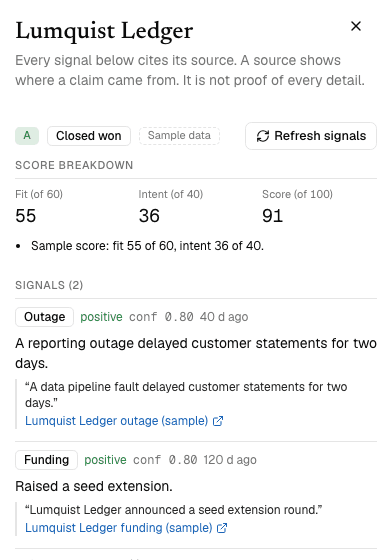
Pathwise is an AI go-to-market engine for small sales teams. It cites each fact it finds, and a person approves every message.
600+ tests on a real graph database. 45 theorems in Lean 4.
A small sales team does this work in five places.
- A deck
- Web search
- A contact tool
- Hand-written messages
- A spreadsheet
Context is lost at each handoff. AI tools add a new risk: claims with no source, and messages that nobody approved. Pathwise puts the work in one place and closes both gaps.
Two rules the code enforces. Not the prompt.
No source, no write.
The write layer rejects a claim with no source. The quote comes from the search provider, never from the model. A second, independent check re-reads the cited page and marks each quote as found, not on the page, or unreachable.
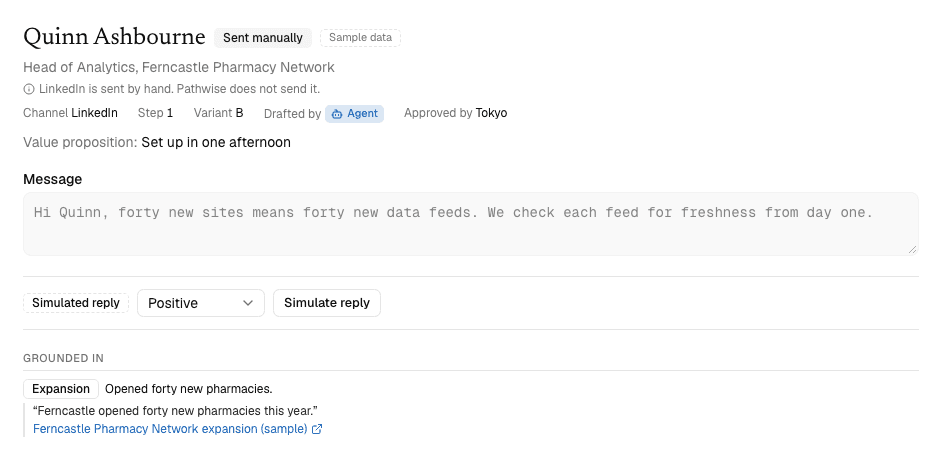
Nothing leaves without a human.
Only a rep credential can approve or send. The agent token cannot. The approval is bound to a hash of the exact subject, body and recipient, so an edit after approval clears it.
Try the rule
- To
- [email protected]
- Subject
- Forty new data feeds
Draft. A person must approve it before it can leave.
From a one-pager to a sent message.
- 1
Intake
Describe the product in a form or a chat, or upload a one-pager.
- 2
Ideal customer profile
Each field has a confidence and the evidence for it.
- 3
Discovery
Real companies and people. Each fact has a link and the exact quote.
- 4
Knowledge graph
Companies, people, competitors and signals in Neo4j.
- 5
Scoring
0 to 100, tiers A, B and C, with the reasons.
- 6
Outreach drafts
Email and LinkedIn. Each draft must cite a real signal.
- 7
Approval
A person approves each message. An edit clears the approval.
- 8
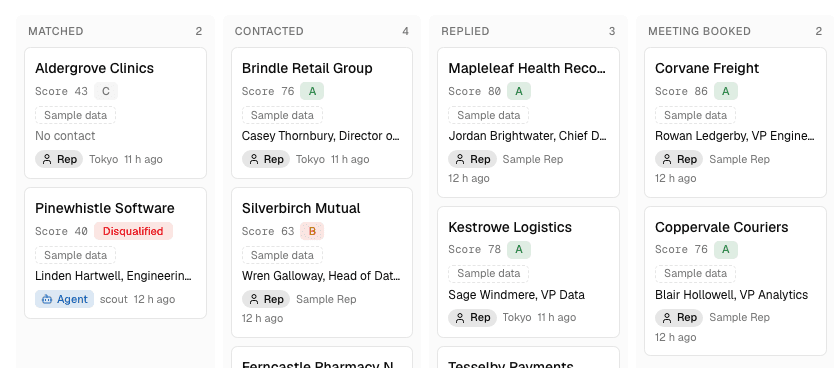
Pipeline
A board that records who did each step: agent or person.
- 9
Analytics
Credits, and the AI cost of each lead.
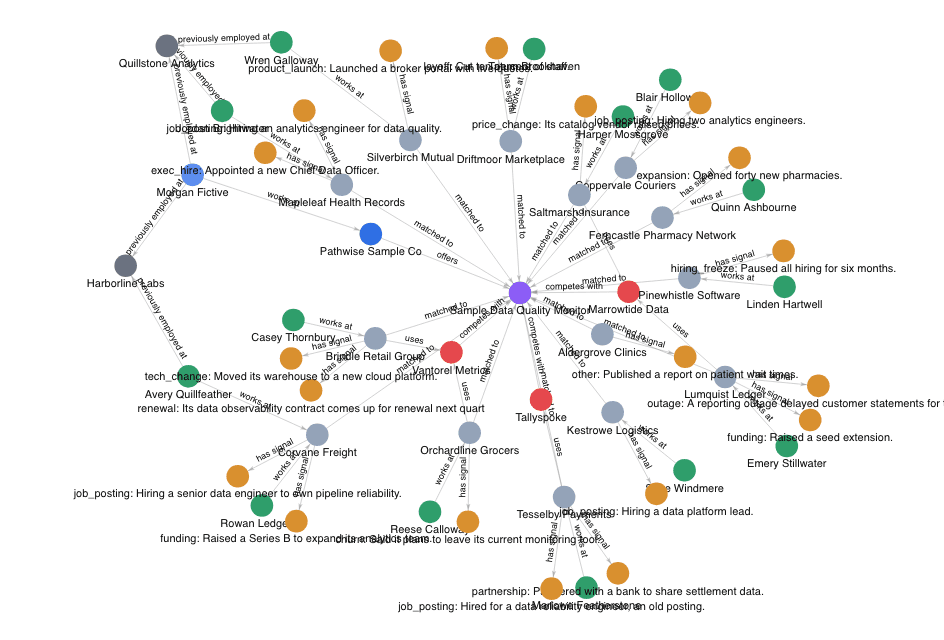
We tested the rules that matter most. Two are proven in Lean 4.
600+
automated tests. They run against a real graph database, not a mock.
45
theorems in Lean 4. They prove that no message sends without approval, and that the credit balance never goes below zero.
Attacked on purpose
Four independent adversarial reviews attacked the approval and billing paths. The system design document lists what they found.
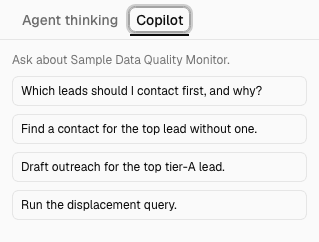
It works where your agents work.
- A copilot in the app
- It can find, enrich and draft. It cannot approve or send.
- An MCP endpoint
- Other AI clients use the same tools, under the same rules.
- Four role agents in a Band room
- Planner, Builder, Reviewer and Security work in the room and stop for the human.
Built to run as a business.
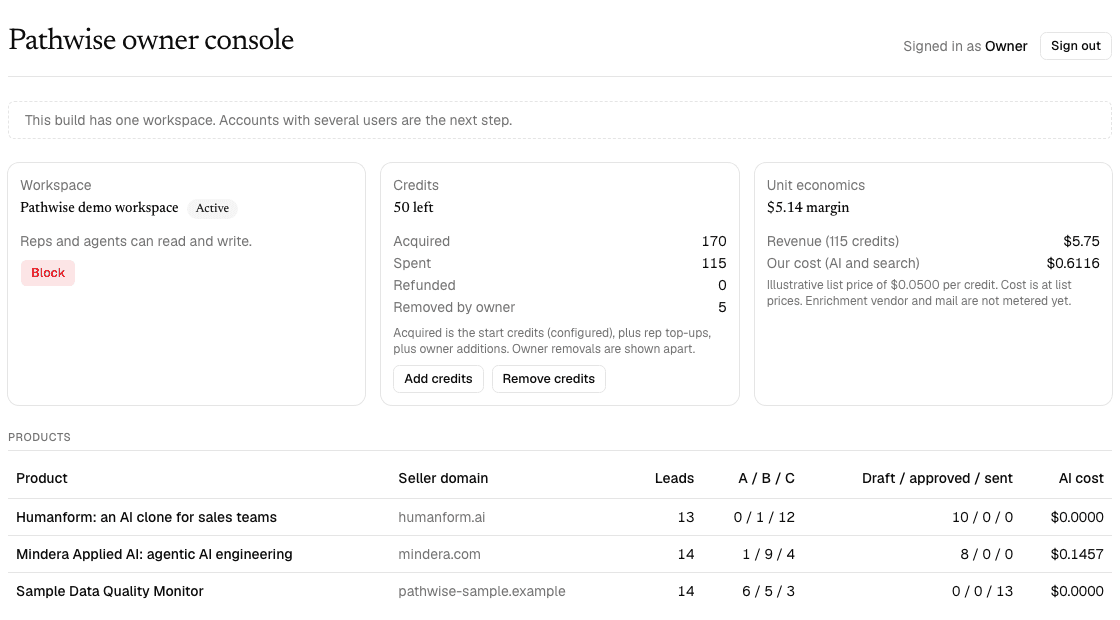
Usage credits with a gate, an owner console with cost and margin for each workspace, and an audit trail with a request ID on every action.
- Enrich a lead
- 10credits
Enrich a lead - Send a message
- 2credits
Send a message - Run a graph query
- 1credit
Run a graph query
What is real today
This is a hackathon build. Here are its limits.
- Every email goes to a team test inbox. No real person receives a message.
- LinkedIn messages are copied and sent by hand.
- The demo data on the hosted app is synthetic and labelled.
- Email addresses are pattern guesses unless a live lookup is turned on.
Built with
- Neo4j
- Lean 4
- Anthropic
- OpenAI
- Brave Search
- Band
- Flexprice
- Teamily AI
- TinyFish
- RocketRide
- Moss
- Clerk
- Hunter
- Resend
- Snyk
- Next.js